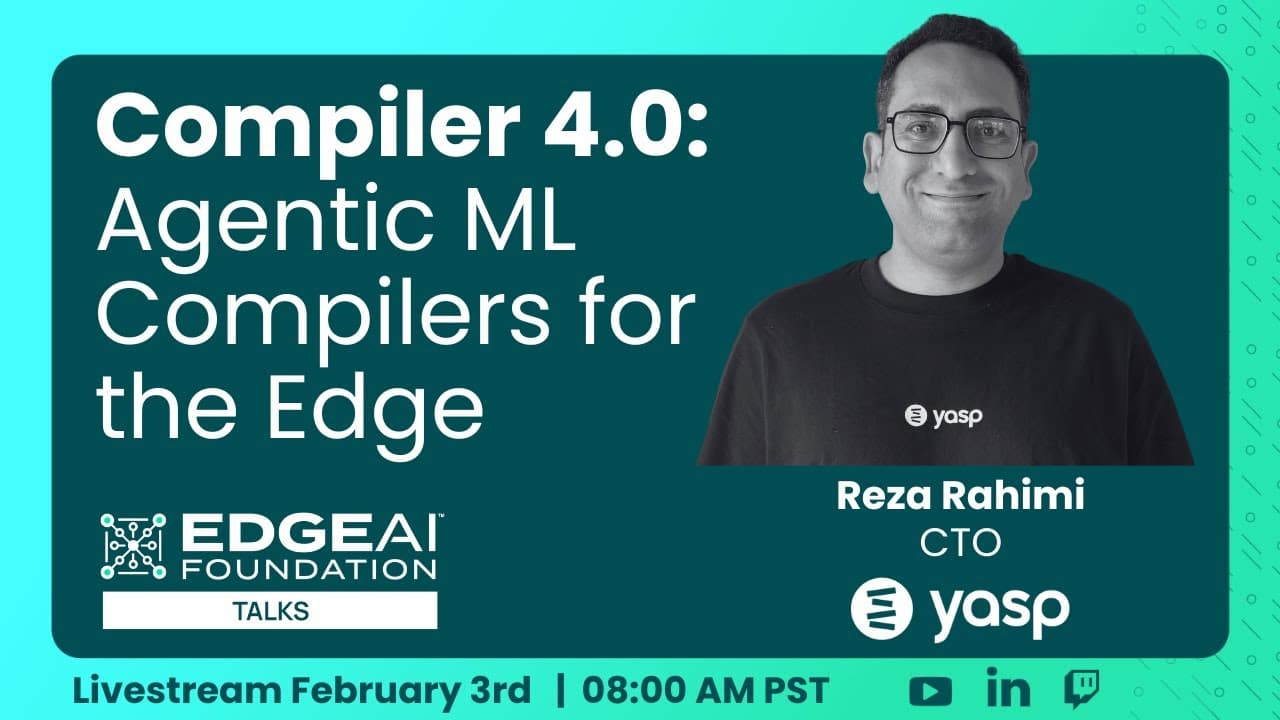
Compiler design has in computing. Early compilers translated human-written assembly into machine code (Compiler 1.0). Optimizing compilers such as GCC and LLVM/Clang automated code transformation and hardware-specific lowering for CPUs (Compiler 2.0). More recent ML compilers, including XLA, TVM, TorchInductor, and MLIR-based stacks, shifted compilation from programs to computational graphs, enabling operator fusion and accelerator-specific kernel generation for GPUs and NPUs (Compiler 3.0). Despite these advances, Compiler 3.0 systems face scalability limits. The growing diversity of model architectures and hardware targets creates a combinatorial optimization problem that cannot be efficiently solved with static heuristics or bounded kernel search. At yasp we build yasp.compile, a Compiler 4.0, an agentic ML compiler paradigm that reasons explicitly about hardware constraints and generates low-level implementations tailored to a specific model–hardware pair. By combining hardware-aware graph optimization with learned code generation and cost modeling, yasp.compile aims to reduce manual kernel engineering and improve adaptability across heterogeneous edge accelerators.