Published by the EDGE AI FOUNDATION Industry Marketing Working Group
The Problem: Cloud-First Promised Everything and Left Gaps We Can No Longer Ignore
For the better part of a decade, “cloud-first” was the architecture that made the smart home possible. Without it, we wouldn’t have voice assistants that understand natural language, security cameras that recognize faces, or thermostats that learn your schedule. The cloud gave us the processing power we didn’t yet have at home, and it worked.
But as smart home adoption has matured, so has our understanding of its limitations. Cloud-first architectures introduced four compounding problems that are now impossible to ignore:
Latency. When your doorbell has to send data to a server hundreds of miles away before deciding whether to ring, the result is a half-second delay that feels broken. When your voice assistant needs 1–2 seconds to respond to “turn off the kitchen lights,” it is annoying and you stop using it.
Privacy. Every raw audio clip, video frame, and sensor reading transmitted to a cloud server is data that has left your home. Whether it’s stored, analyzed, or shared downstream is often not clear and if it is monetized, used for profiling or advertising is often covered but not explicit under click-through agreements. For millions of households, this has become a genuine and growing concern.
Reliability. Smart home devices that depend entirely on cloud connectivity become dumb devices the moment the internet goes down. For the average American household, this happens more than you might think. A security camera that stops recording during an outage can be worse than no camera at all.
Cost. Cloud video storage, inference compute, and managed AI services carry recurring costs that squeeze both consumer wallets and product margins. As smart home ecosystems scale, these costs compound fast.
These are the structural limitations of cloud-first design. They also explain why, despite years of investment and marketing, smart homes still create more friction than they remove.
Let’s make this concrete.
A Morning in an American Home
It’s 6:45 AM in a house in Columbus, Ohio. Before anyone has opened their eyes, the thermostat has already been at work, responding to patterns it has learned over months. It knows that this household wakes around 7:15 AM on weekdays, that the bedroom takes about 30 minutes to reach a comfortable temperature from overnight setback, and that Tuesday mornings in April still carry a chill. The room is already warming. No one had to configure this. No data left the house.
By the time the kitchen registers movement at 7:10 AM, the coffee machine has already begun its cycle. It did this not because it was told to do so at a certain time, but because a sensor detected presence and inferred intent. Separately, the doorbell catches a neighbor approaching the front walk. Locally, on the device itself, a small model has already classified the visitor: known face, no alert needed. A delivery van parks at the curb, a different classification, brief notification, and thumbnail only. No video stream has been uploaded. No cloud server was consulted for either decision.
At 8:00 AM, the robot vacuum begins its run. It pauses near the hallway. The on-device vision model has detected something the manufacturers delicately refer to as a “hazard”: the dog has had an accident. The vacuum reroutes. No embarrassing incident. No ruined brushroll. The decision was made entirely on the device, in milliseconds.
The house goes quiet through the workday. Then, at 4:00 PM, a sensor cluster in the living room registers an unusual pattern: a rapid change in position, sustained stillness, no subsequent movement recovery. The system cross-references ambient signals. A fall is confirmed. Emergency services are contacted automatically. A caregiver is notified. The entire detection chain happened locally, without streaming video, without exposing a vulnerable person to unnecessary surveillance.
By 6:30 PM, someone is cooking. A small camera above the stove notices that a burner has been left on while its user has stepped away. An alert fires to their phone in under a second. Simultaneously, the range hood has already increased its speed in response to a rising smoke signature. No one burned anything.
None of this is science fiction or requires a subscription to a premium cloud tier. It is, in essence, what Edge AI makes possible:dependable, respectful micro-automations that quietly remove friction and maintain safety, day after day.
The Solution: Edge AI: Intelligence That Lives in Your Home
So what, precisely, is Edge AI?
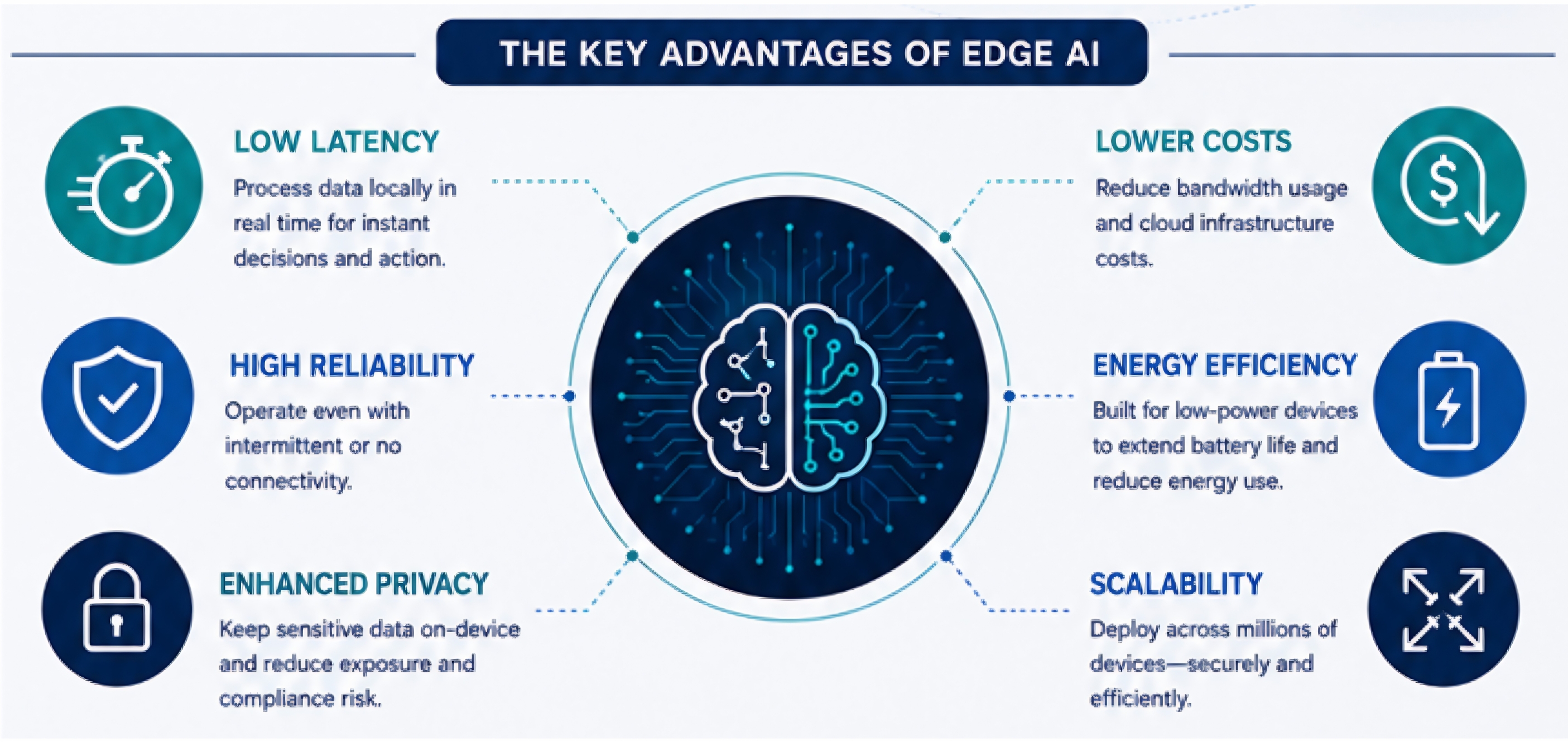
The definition is simpler than the marketing around it suggests: Edge AI runs AI inference models on the device itself, rather than sending raw data to a remote server for processing. Whether the device is a camera, thermostat, hub or sensor, intelligence lives where the data is generated.
This architectural shift has four immediate and practical consequences:
- Lower latency. On-device inference operates in milliseconds, not the hundreds of milliseconds to seconds required for a cloud round-trip. For time-sensitive applications such as fall detection, hazard alerts, and voice response, this difference is not marginal. It is the difference between the system being useful and it being too slow to matter.
- Stronger privacy. When inference happens locally, raw images, audio clips, and sensor readings do not need to leave the home. When something is transmitted,it is a processed output: an event classification, an alert, or a summary. The underlying data stays on-device.
- Improved reliability. Edge AI keeps working when the internet doesn’t. Local models don’t care about ISP outages, router failures, or cloud service disruptions. Core safety and comfort functions remain available regardless of connectivity.
- Reduced cost. Cloud compute, cloud storage, and cloud video analysis are recurring line items that scale with usage. Moving inference to the edge reduces what needs to be sent, stored, and processed in the cloud. This lowers costs for both consumers and the companies building products for them.
 It’s worth being precise about one thing: Edge AI does not mean no cloud. The most sophisticated smart home products today use a hybrid architecture that combines the strengths of both. A voice assistant might handle wake-word detection and common commands entirely on-device, then route complex natural-language queries to the cloud. A security camera might perform person detection locally, upload only flagged event clips, and rely on the cloud for long-term storage and model updates. This is not a compromise; it is good engineering. The goal is to do on the edge what the edge does best, and reserve the cloud for what genuinely requires it.
Why Now? The Market and Technology Have Finally Aligned
Edge AI for the home is not a new idea. What is new is that the enabling conditions have all arrived at the same time.
The silicon and software are ready. Microcontrollers and neural processing units (NPUs) capable of running real AI inference are now cheap enough to embed in doorbells, thermostats, and smart hubs. The models that run on them have been compressed and optimized to deliver meaningful accuracy within the power and memory budgets of always-on devices. What once required a server rack can now run on embedded devices with only a few megabytes of RAM, sub-1GHz processors, and lightweight RTOS or bare-metal environments.
The standards are maturing. The Matter and Thread protocols are gradually delivering on a long-standing promise: devices from different manufacturers that actually work together, reliably, on a local network. As cross-brand routines become more dependable, the value of local processing compounds. For example, a fall detected by a sensor can trigger a response across a coordinated device ecosystem without a cloud intermediary in the loop.
Consumer sentiment has shifted. Privacy expectations are no longer niche concerns held by the technically sophisticated. They are mainstream. Regulatory pressure is rising. And subscription fatigue — the accumulated frustration of paying monthly fees for features that were once included — is pushing both consumers and product teams toward architectures that do more locally.
The economics demand it. Cloud video storage and inference costs are not trivial at scale. As smart home product margins compress, offloading recurring cloud costs to on-device processing becomes a competitive necessity.
The convergence of these four forces is why the smart home industry is undergoing a genuine architectural shift, and why Edge AI is at the center of it.
Use Case Deep Dives: Where Edge AI Changes the Experience
The Doorbell That Thinks Before It Pings You
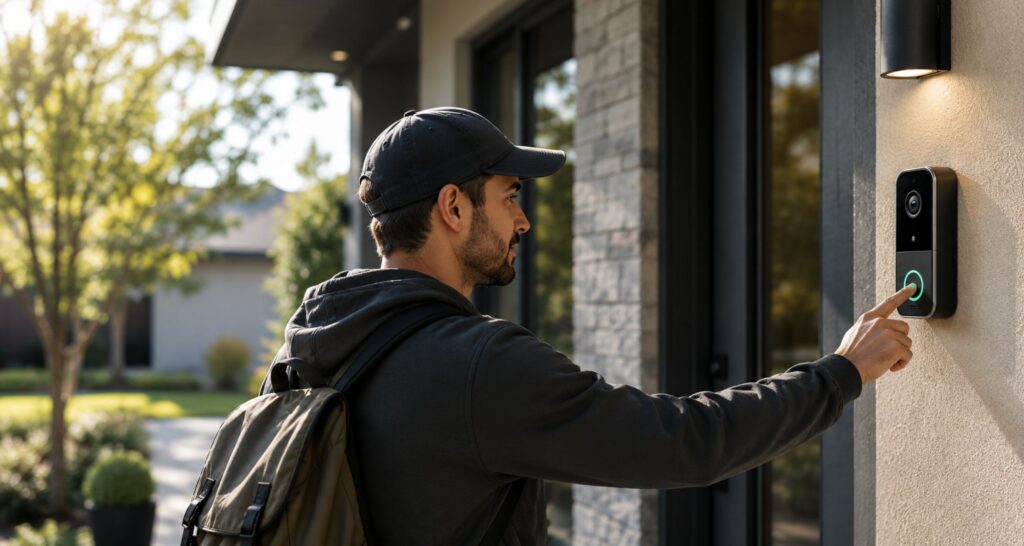
The modern video doorbell was supposed to give homeowners peace of mind. In practice, it has given them alert fatigue. Squirrels, passing cars, blowing leaves, and shadows trigger push notifications at all hours, until most users simply turn notifications off, defeating the purpose entirely.
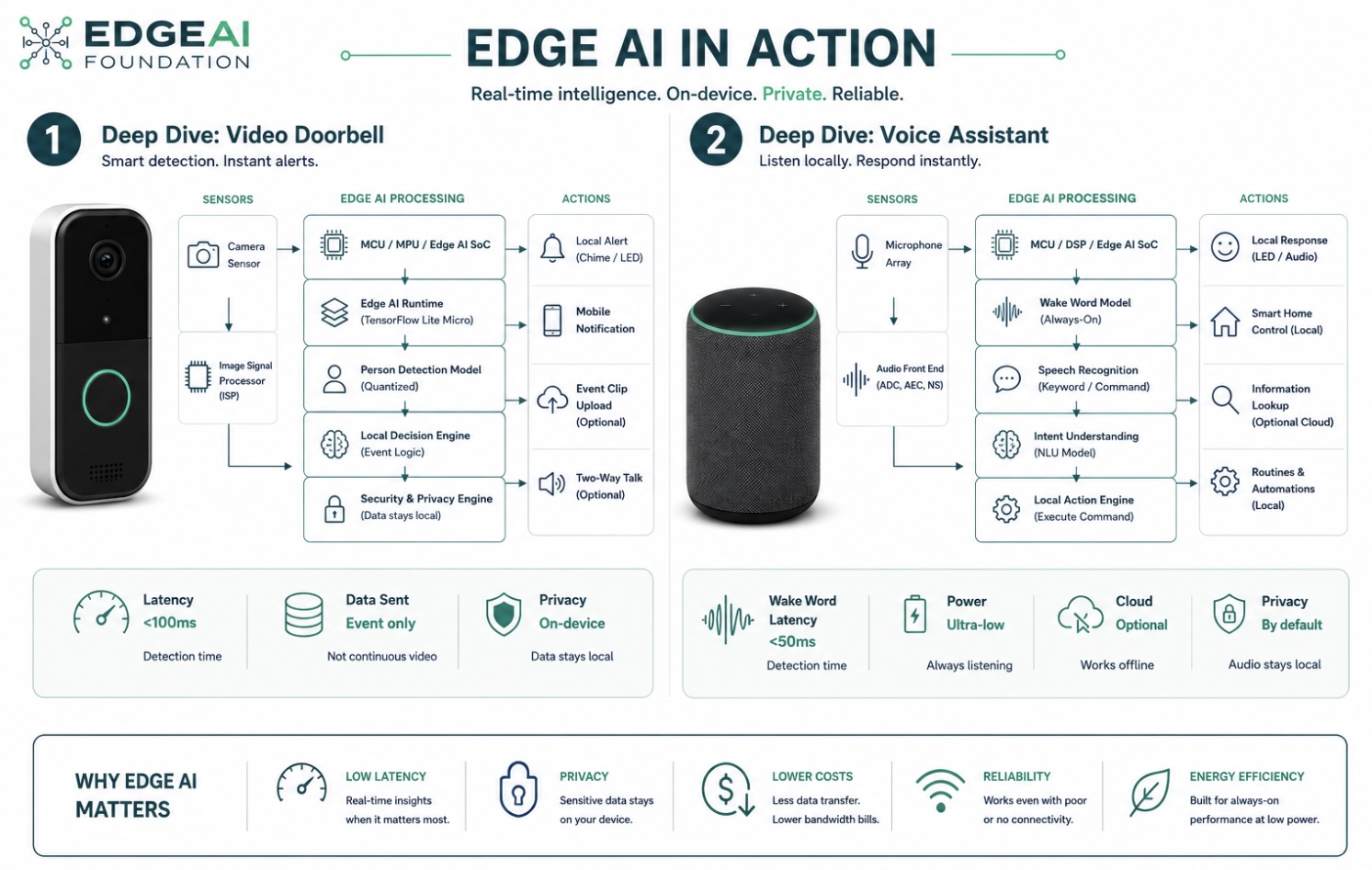
The practical gains are significant. Compared to motion-only detection systems, on-device classification delivers 60–80% fewer false alerts. Detection latency drops to under 200 milliseconds, meaning the chime sounds and the notification fires even if the internet is slow or temporarily unavailable. And because only events, and not continuous streams, are uploaded to the cloud, storage costs fall sharply.
The hybrid pattern here is clean and sensible: on-device detection handles the time-sensitive, privacy-sensitive work; the cloud handles clip storage, sharing, and periodic model updates.
Voice Control That Works Offline and Understands Context
The promise of voice-controlled smart homes ran into a stubborn reality: the commands had to be precise, the device had to be addressed directly, and everything stopped working the moment the internet did. Saying, “Hey [Assistant], turn off the living room lights” only worked if you said it exactly right, only to the right device, and only if the cloud was reachable.
Edge AI enables a fundamentally different model. Local wake-word detection and on-device speech recognition allow common commands such as lights, scenes, routines, and volume to execute in approximately 50 milliseconds, with no cloud dependency. Outages no longer mean silence.
But the more interesting shift is contextual awareness. Rather than requiring explicit, device-specific commands, an Edge AI-enabled voice system can link what it hears to what it sees and senses in the room. How many people are present? Are they adults or children? What is the current state of the lights, the thermostat, the TV? What room is the speaker standing in? These contextual signals allow natural, ambient commands like, “dim it down a bit,” or “make it cozy in here,” to be interpreted intelligently rather than literally.
The result: 20–40% faster perceived response time, significantly fewer failed commands, and a voice experience that continues to function when connectivity drops. Complex or open-ended queries that genuinely require cloud NLP still route there, but the everyday interactions that define the experience no longer depend on it.
Energy-Savvy HVAC That Learns Your Home’s Rhythms
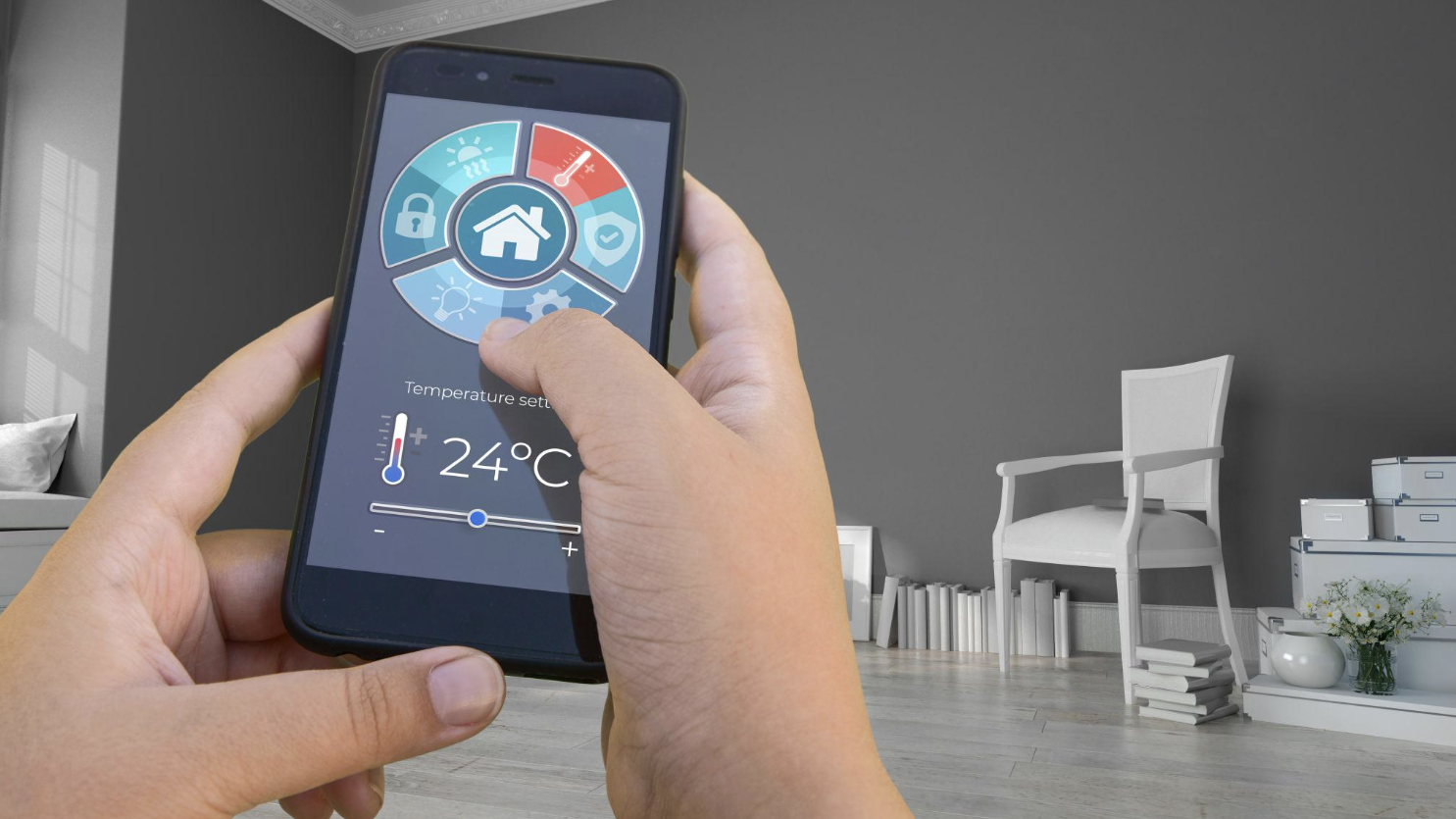
Heating and cooling account for roughly half of a home’s energy consumption. Programmable thermostats were supposed to optimize this. They largely failed, because most people never program them, and those who do find that fixed schedules don’t match the fluid reality of how households actually use their space.
Edge AI enables a different approach. Local occupancy detection, using passive infrared, ultrasonic sensing, or camera-based analysis that never transmits imagery, allows an HVAC system to heat or cool only the rooms that are actually in use. Window-open sensing prevents conditioning air that’s escaping. Models that run on-device learn the thermal dynamics of a specific home: how long the master bedroom takes to warm, how the kitchen heats up naturally while dinner is being cooked, how Sunday mornings differ from Tuesday evenings.
In markets with time-of-use electricity pricing, local inference can shift runtime to off-peak hours while maintaining comfort targets. The estimated savings, from $15–$40 per month in relevant markets, are meaningful to households and compelling in product marketing.
The hybrid pattern is well-suited here: local inference handles real-time occupancy and comfort optimization; the cloud pulls current utility rate schedules and can push refined scheduling models as they improve.
Aging in Place Without the Feeling of Surveillance
For older adults living independently, the tension between safety and dignity is real and underappreciated. Families want assurance; the people they’re caring for don’t want to feel watched. Traditional remote monitoring where cameras stream footage to a family member’s phone resolves the safety concern while creating a new one.
Edge AI offers a different path. Instead of streaming video, on-device models analyze movement patterns, activity rhythms, and behavioral signatures. A fall is detected by recognizing a pattern: rapid position change, sustained stillness, or absence of recovery movement. Daily activity summaries such as”usual morning routine completed,” or “less active than typical this afternoon,” give caregivers meaningful signals without surveillance-level access.
The benefits compound across the population. False alarms are reduced because the system is responding to verified behavioral anomalies, not raw motion. Dignity is preserved because no video stream leaves the home unless explicitly authorized. And the people being monitored can participate in setting the boundaries of what gets shared and what stays local.
The hybrid pattern: edge activity recognition handles the real-time, privacy-sensitive detection; cloud dashboards and escalation workflows allow caregivers to receive digests, configure alerts, and coordinate responses.
Benefits at a Glance
For Households (End Users)
- Faster, more reliable responses — core functions work even when the internet is down
- Fewer false alerts — smarter local detection means notifications that are worth reading
- Stronger privacy — raw audio, video, and sensor data stays on-device by default
- Lower ongoing costs — reduced dependence on cloud subscriptions and storage tiers
- Comfort that adapts — systems that learn the actual rhythms of a household, not a generic schedule
- Safety without surveillance — fall detection, hazard alerts, and anomaly sensing that respects dignity
For Product Managers (Building the Product)
- Reduced cloud infrastructure costs — offloading inference to the edge lowers per-unit recurring costs at scale
- Differentiated privacy story — local processing is a genuine and marketable competitive advantage
- Higher user retention — reliability and reduced alert fatigue drive better long-term engagement
- Regulatory resilience — on-device processing reduces data handling obligations and exposure
- Faster iteration on UX — local inference latency unlocks interaction patterns that cloud latency made impossible
- Hardware moats — on-device AI capability tied to proprietary silicon or model optimization is defensible
Risks, Ethics, and What Not to Do
Edge AI in the home is powerful. That power comes with responsibilities that the industry is still learning to take seriously.
Test for bias across diverse conditions. AI models trained on narrow datasets perform poorly in the real world. Smart home models must be tested across diverse household compositions, lighting conditions, home layouts, and the full variety of pets, children, visitors, and routines that real homes contain. A fall detection model that works in a well-lit suburban living room but fails in a dimly lit apartment is a liability.
Take security seriously at the hardware level. On-device AI introduces new attack surfaces. Regular firmware updates, local-only processing modes where appropriate, hardware root of trust, and clear disclosure of what data leaves the device are baseline requirements.
Be transparent about what runs where. Users should be able to see, in plain language, what their devices processed locally versus what was sent to the cloud. Activity logs, simple privacy dashboards, and clear opt-in/opt-out controls are increasingly expected by regulators and consumers alike.
What’s Next: The Intelligent Home of the Near Future
The architectural shift toward Edge AI is the beginning of a longer trajectory. Several developments on the near horizon will define the next chapter.
Local small language models for home automation. The large language models that power cloud-based assistants today are rapidly being compressed into forms that can run on powerful home hubs. Within the next few years, natural-language routine creation, device interoperability reasoning, and contextual home management will be achievable without a cloud connection. A homeowner will be able to say, “I want the house to feel quieter and cooler when I’m working from home on Fridays,” and a local model will translate that intent into coordinated device behavior.
Multi-device collaboration. The most capable smart home systems of the future will not be collections of independent devices, they will be coordinated sensor networks. Cameras, motion sensors, HVAC systems, and lighting will share local inference to build a richer, more accurate picture of what is happening in the home and respond accordingly. The whole will be meaningfully smarter than the sum of its parts.
Automation that explains itself. Trust is the unsolved problem of smart home technology. Systems that act without explanation, even when they act correctly, feel uncanny and erode confidence. The next generation of Edge AI products will need to surface their reasoning in human terms: “I turned the heat down because the bedroom window has been open for 20 minutes.” Explainability is the mechanism by which automation earns permission to do more.
Homes as intelligent microgrids. As rooftop solar, home battery storage, and EV charging become mainstream, the home’s energy systems will require real-time, local optimization that no cloud service can coordinate quickly enough. Edge AI will be the intelligence layer that balances storage, generation, consumption, and grid interaction. In this way, it will reduce costs and reduce carbon, doing so without sending every energy decision to a remote server.
The smart home has spent a decade promising to make life easier. Edge AI is what makes that promise structurally credible by giving the devices already in our homes the intelligence to act locally, reliably, and respectfully. The question is no longer whether on-device AI belongs in the home. It is how quickly the industry can build it well.
Call to Action: Visit EDGE AI FOUNDATION Solutions